
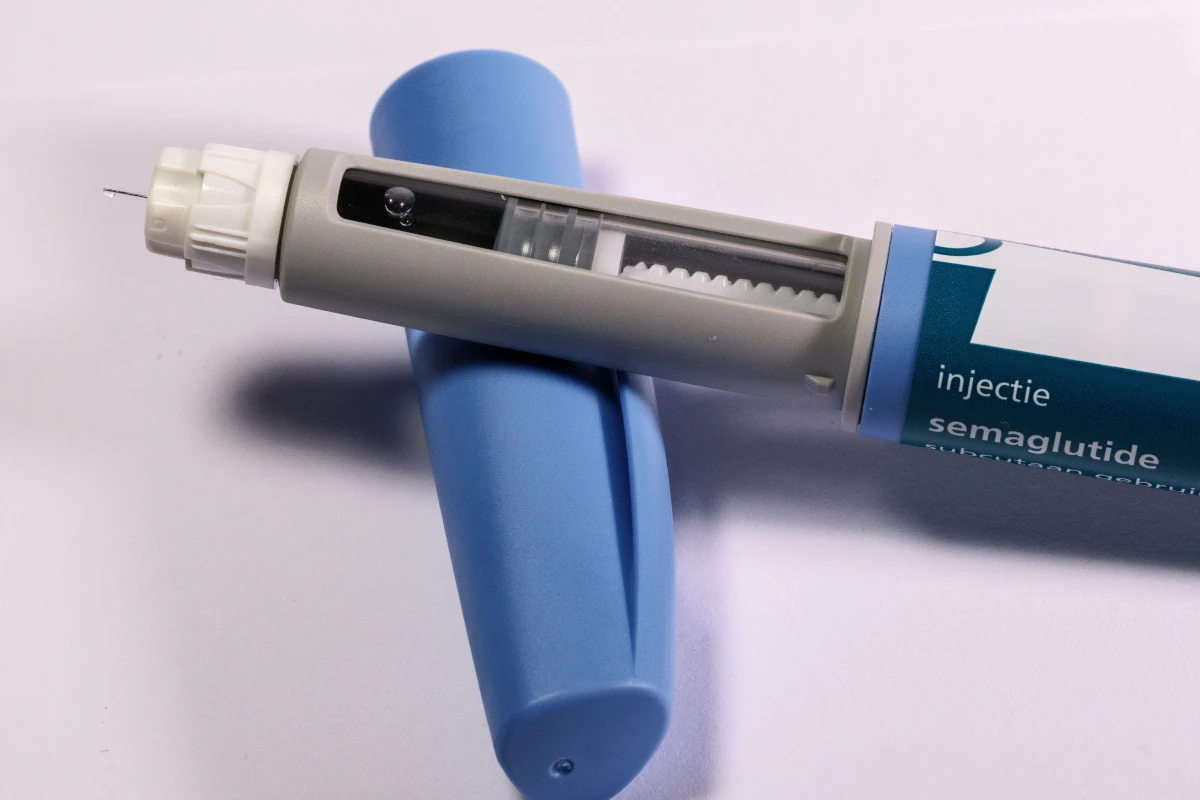
Skin reactions to Ozempic get talked about a lot more than they happen, and most of what people describe to us turns out not to be an allergy. A red, itchy patch where you gave yourself the injection and hives spreading across your body an hour after the dose are two separate problems with two different answers.
Everyday conversation calls both of them an allergy, and most of the advice online collapses them into the same warning. Here is how we separate them, and what actually needs an allergist.
What an Ozempic rash usually looks like
The most familiar complaint is a reaction at the injection site: redness, some swelling, itching, and sometimes a small firm bump under the skin. It shows up within minutes to a day of the injection, stays in the area where the needle went in, and fades on its own.
These are less common than you would guess from how much they get discussed. In the placebo-controlled trials, injection site reactions such as discomfort and redness were reported in 0.2% of patients taking Ozempic. Rash and hives appear in the postmarketing reports rather than the trial tables, which means they happen but the trials weren’t large enough to pin down how often.
A local reaction is irritating, and it stays local. Your immune system has not decided semaglutide is dangerous.
A rash that appears somewhere the injection never went means something else. If you inject in your abdomen and get a rash on your arms, chest, or back, the drug is circulating and the reaction is systemic. That is worth having looked at.
How long does an Ozempic rash last?
Injection site reactions usually settle within a few hours to a few days. If you are still seeing redness at the same spot a week later, or the area is warm, painful, or producing pus, that is more likely an infection than an allergy and should be seen quickly.
A widespread drug rash follows a slower course. These can take one to two weeks to clear even after the drug is stopped, and they sometimes get worse for a day or two before improving. Rashes that peel, blister, involve the mouth or eyes, or come with fever need same-day medical attention rather than a wait-and-see approach.
Hives behave differently again. Individual hives come and go within 24 hours, though new ones can keep appearing for as long as the trigger is around.
One thing worth knowing if you have stopped the drug and are waiting for symptoms to settle: semaglutide has a half-life of about a week, and stays in the circulation for roughly five weeks after the last dose. Stopping it does not clear it from your system quickly, so a reaction that fades slowly is not necessarily a sign that something else is going on.
Hives, swelling, and the reactions that point to true allergy
A genuine allergic reaction to semaglutide is rare, but it does happen and it has been reported since the drug came to market. The features that suggest it:
Hives (raised, itchy welts) that appear within minutes to a couple of hours after a dose, particularly if they show up after more than one injection.
Swelling of the lips, tongue, face, or throat, which is angioedema.
Wheezing, chest tightness, throat tightness, difficulty swallowing, or a sudden drop in blood pressure. Together with skin symptoms, these point toward anaphylaxis.
Timing matters more than most people expect. A reaction that starts within an hour of the injection and involves more than one body system is treated very differently from a rash that appeared four days later.
If you have symptoms of anaphylaxis, use epinephrine and call 911. Epinephrine is available as an autoinjector (EpiPen, Auvi-Q) and as a nasal spray (neffy). If you are weighing up which option suits you, we compare them here: Auvi-Q vs EpiPen.
Antihistamines have a role after epinephrine has been given, since they help with the histamine-driven part of the reaction such as itching and hives. They are not a substitute for epinephrine and should not be relied on as the treatment for a serious reaction.
What people are usually reacting to
The drug molecule itself is only one of the possibilities.
Ozempic pens contain three inactive ingredients alongside the semaglutide: phenol, propylene glycol, and disodium phosphate dihydrate, in water for injection. Phenol is the preservative, and it is there because the pen is used over several weeks and needs to stay sterile between doses. Propylene glycol keeps the solution stable.
Both of the first two are worth knowing about. Propylene glycol is a recognized contact allergen and turns up in patch testing for reactions to creams, ointments, and other injectables. Phenol is a standard preservative in multi-dose pens and is well tolerated by most people, but preservative reactions in injectable medications are well described. Either can produce a reaction that looks like a drug allergy but isn’t one, which matters because switching to a formulation without the offending ingredient sometimes solves the problem entirely and lets you stay on the medication.
Ozempic comes in two forms, and they do not contain the same inactive ingredients. The multi-dose pen contains phenol and propylene glycol. The single-dose prefilled syringe contains disodium phosphate dihydrate, sodium chloride, and water, with no phenol and no propylene glycol, because a single-use syringe does not need a preservative.
So if your reaction is to phenol or to propylene glycol rather than to semaglutide, the syringe formulation may be an option where the pen is not. That is a conversation for your allergist and your prescriber together, and it is the kind of detail that gets missed when a reaction is written off as an allergy to the drug.
This is also why the prescribing information contraindicates the drug after a serious hypersensitivity reaction to semaglutide or to any of the excipients in Ozempic. The excipients are part of the picture, not a footnote to it.
Compounded semaglutide sits in its own category. These products are not the same as the FDA-approved pens, and some contain different salt forms of semaglutide or different inactive ingredients. If your reaction started after you moved from a branded pen to a compounded vial, or you have only ever used a compounded product, bring the vial and its labelling to your appointment. That detail changes the evaluation.
Injection technique produces its own version of this. Injecting into the same spot repeatedly, injecting cold medication straight from the fridge, or leaving alcohol on the skin before the needle goes in all cause local irritation that can look like a reaction.
Other GLP-1 medications
The same questions come up across the whole class, and the answers are broadly similar.
Semaglutide is sold as Ozempic and Wegovy for injection, and Rybelsus as a tablet. Tirzepatide is sold as Mounjaro and Zepbound, and works on both GLP-1 and GIP receptors. Older medications in the family include liraglutide (Victoza, Saxenda), dulaglutide (Trulicity), and exenatide.
Reacting to one does not automatically mean you will react to the others. Ozempic’s labelling advises caution in anyone who has had angioedema or anaphylaxis with a different GLP-1 medication, because it is not known whether those patients will react again. Caution is not the same as a prohibition, and the difference between the two is what testing is for.
We published a case in Clinical Case Reports in 2026 describing a patient who reacted to tirzepatide and went on to tolerate semaglutide. Intradermal testing to tirzepatide was positive, intradermal testing to semaglutide was negative, and a supervised subcutaneous challenge with semaglutide was uneventful. She has continued on it since. That is one patient rather than a rule, and it does not mean the reverse switch is automatically safe, but it does show the class is not necessarily all-or-nothing.
If you reacted to Mounjaro or Zepbound, our page on tirzepatide allergy goes into that side in more detail.
Can Ozempic cause food allergies?
This comes up more than you would guess, usually from people who have started reacting to foods they used to eat without trouble.
Ozempic does not cause food allergies. What it does is slow how quickly food leaves the stomach, which is part of how it works. That delay can change how you experience eating: fullness after small amounts, nausea, reflux, and discomfort after fatty or heavy meals. People understandably read that as a new intolerance to a specific food.
There is a separate scenario worth knowing about. If you already have a food allergy, changes in how quickly food is absorbed can in theory alter how a reaction unfolds, though this is not well studied. If you have a known food allergy and you have started a GLP-1 medication, keep your epinephrine with you as you always would and tell your allergist you are on it.
If foods that were previously fine are now producing hives, swelling, or breathing symptoms, that is a new food allergy question rather than a medication side effect question, and it deserves proper testing.
What we do at an allergy evaluation
There is no commercially manufactured skin test for semaglutide the way there is for penicillin, and no standardized testing protocol has been published for this class of drug. The workup has to be built around the patient in front of us instead.
It starts with the history. What the reaction looked like, how long after the dose it began, how long it lasted, which product and which pen you were using, what else you took that day, and whether it has happened more than once. Photographs are genuinely useful here, so take them at the time even if the rash has gone by your appointment.
From there, skin testing with the medication itself. Percutaneous (prick) testing first, then intradermal testing if the prick test is negative and the history still points at the drug. Our own published case involved a patient whose prick test to her medication came back negative while an intradermal test at a tenth of the strength was clearly positive. Stopping at the prick test would have given her the wrong answer.
If testing suggests you can tolerate a different medication in the class, the next step is a supervised challenge. A small starting dose given in the office with monitoring afterwards, so that if anything happens it happens with a physician in the room rather than at home.
Bloodwork has a role too, mainly to rule out the conditions that mimic drug reactions. Hereditary and acquired angioedema are the important ones, and they are excluded with C1 esterase inhibitor levels and function plus complement studies rather than assumed away.
The outcome we are aiming for is an answer to a practical question: can you keep taking this, do you need a different formulation, do you need a different drug in the same class, or do you need to stop entirely? Being told to simply avoid a medication that was working is not a satisfying end point, and it is often not the right one.
When to stop the medication and call
Stop and seek emergency care for throat tightness, difficulty breathing, swelling of the lips or tongue, dizziness or fainting, or a rash with fever, blistering, or peeling.
Book an allergy appointment for hives after doses, rashes away from the injection site, reactions that get worse with each injection, or any reaction that made you stop a medication you would rather still be taking.
For a mild injection site reaction that settles on its own, mention it at your next diabetes or weight management appointment. It usually does not need us.
Anything that involves changing or stopping a prescription should go through the doctor who prescribed it. Do not stop diabetes medication on your own.
Frequently asked questions
Can Ozempic cause a rash? Yes, though less often than the amount of discussion suggests. Injection site reactions were reported in 0.2% of patients in the trials. Rash and hives are recognized in postmarketing reports. A rash away from the injection site should be evaluated.
How long does an Ozempic rash last? Injection site reactions usually clear within a few hours to a few days. A widespread drug rash can take one to two weeks. Individual hives fade within 24 hours, though new ones may keep appearing. Semaglutide stays in the body for about five weeks after the last dose, so symptoms can take time to settle after stopping.
Can you be allergic to Ozempic? Yes, though it is uncommon. True hypersensitivity reactions to semaglutide have been reported, including hives, angioedema, and anaphylaxis. Many reactions turn out to involve inactive ingredients rather than semaglutide itself.
What does an allergic reaction to Ozempic look like? Hives, swelling of the face or lips, itching away from the injection site, wheezing, or throat tightness, usually starting within minutes to a couple of hours of the dose.
Can Ozempic cause a rash on your face or legs? A rash anywhere other than the injection site suggests a systemic reaction rather than local irritation. It should be evaluated rather than treated as a normal side effect.
Does Ozempic cause itching without a rash? Itching alone can happen and has several possible causes, including dry skin from rapid weight loss. Persistent itching with no visible rash, particularly with dark urine or yellowing of the skin, needs prompt medical review for other reasons.
Can you take Wegovy if you reacted to Ozempic? They are the same active drug, so a genuine allergy to one applies to the other. The dose and pen differ, so this is a conversation to have with an allergist rather than an assumption to make either way.
Can you switch to Mounjaro or Zepbound after an Ozempic reaction? Possibly, but not automatically, and this direction is less well documented than the reverse. Published evidence, including our own case report, describes patients who reacted to tirzepatide and then tolerated semaglutide. There is less written about switching the other way. Testing and a supervised challenge are the way to answer it rather than trying the switch at home.
Is compounded semaglutide more likely to cause a reaction? Compounded products are not FDA-approved and can differ in salt form and inactive ingredients. If your reaction is linked to a compounded product, bring the vial and labelling to your appointment.
Do I need to stop my medication before an allergy appointment? Not necessarily, and not without speaking to your prescriber. Do tell us what you are taking and when your last dose was, since some medications including antihistamines affect testing.
Get it evaluated
If you have reacted to Ozempic, Wegovy, Mounjaro, Zepbound, or another GLP-1 medication, our allergists can work out what happened and whether you can keep taking it. We see patients across our New York City locations.
Call (212) 686-6321 to book an appointment.